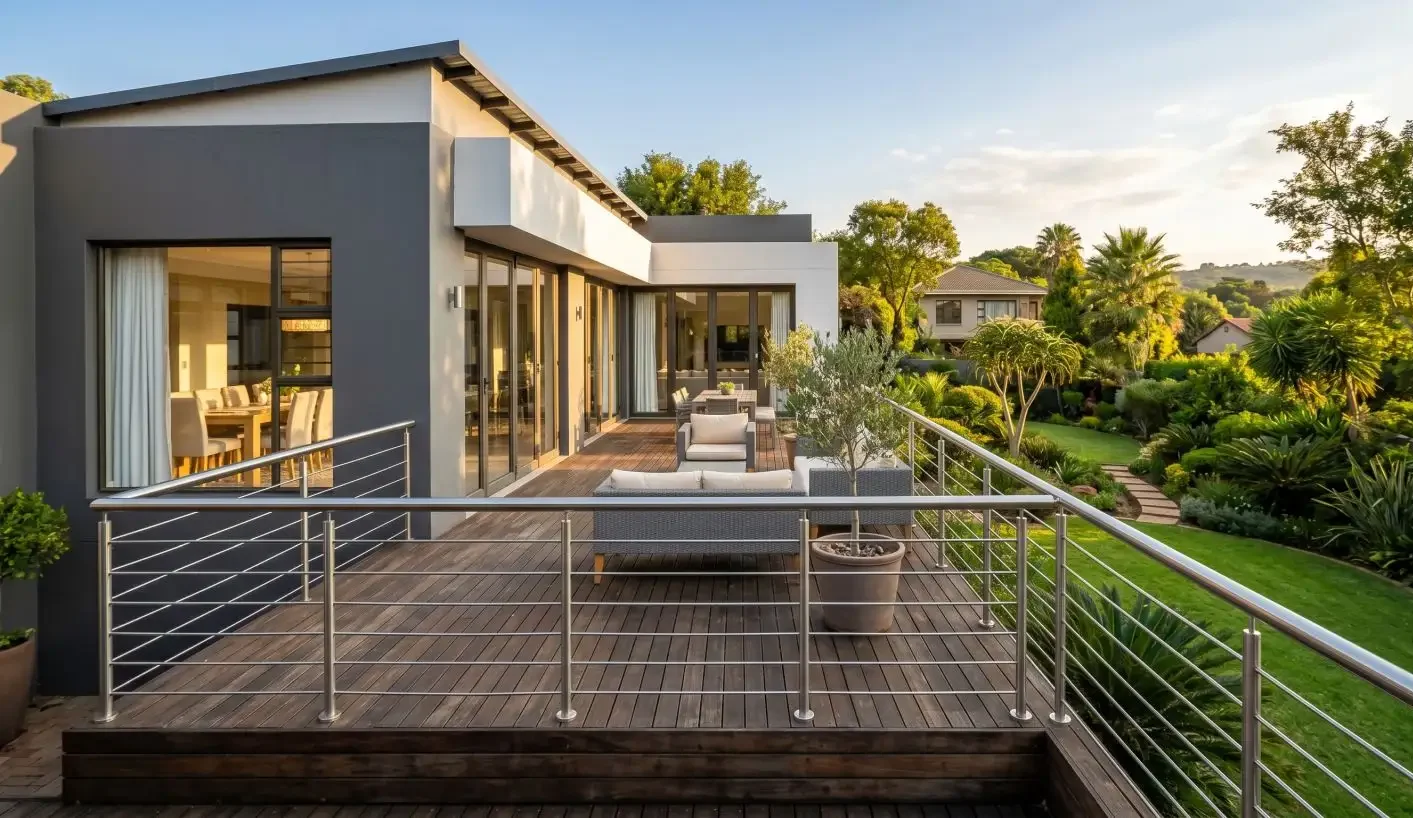
If you have just received a professional balustrade quote and felt your stomach drop, you are not alone. Installation prices in South Africa can easily run to R20,000, R30,000, or more for a standard residential project. What most homeowners do not realise is that a significant portion of that figure is labour — and labour is precisely what a DIY installation eliminates.
This guide breaks down what a stainless steel balustrade actually costs per metre in South Africa, what drives those costs up or down, and how the DIY material-only route compares to a professional supply-and-install quote. The figures here are based on current market pricing and are designed to give you a realistic planning budget before you commit to a single component.
Whether you are planning a deck balustrade, a balcony rail replacement, or a staircase handrail, the numbers below will give you a much clearer picture than a contractor’s summary invoice ever will.
What Affects Balustrade Cost Per Metre?
Before getting into specific figures, it is worth understanding the variables that drive balustrade pricing. Two projects of the same linear metreage can look very different on a quote, and knowing why helps you budget accurately.
- Material and grade — Stainless steel commands a premium over mild steel or aluminium, and 316 Marine Grade costs more than 304. The grade you need depends on your location and application: 316 is essential for coastal properties and pool surrounds; 304 is suitable for inland applications away from sea air.
- Infill style — Round tube infill is the most cost-effective option. Cable infill adds a modern open-feel aesthetic at a higher component cost. Glass infill is the most expensive, primarily because the glass panels themselves are quoted separately by a glazier.
- Post spacing — Wider spacing between stanchions reduces the number of posts required and lowers material cost. The minimum compliant spacing under SANS 10400-M is your baseline; tighter spacing adds posts and cost.
- Run complexity — A straight flat run is straightforward to cost. Corners, staircases, angled sections, and gates all add time, components, and cost.
- DIY vs professional installation — This is by far the largest variable. Labour typically accounts for 50 to 65 per cent of a professional installation quote. DIY eliminates this entirely.
What Does Professional Installation Cost Per Metre?
Based on current market pricing across South Africa, professional supply-and-install rates for stainless steel tube balustrades typically range from R1,500 to R3,800 per running metre, depending on material grade, design complexity, and geographic location. Glass balustrade installations generally start at R2,090 per metre and can reach R4,800 per metre or more for frameless systems.
For a standard 10-metre residential deck or balcony balustrade, that translates to a professional quote somewhere between R15,000 and R38,000. Projects with corners, stairs, or glass panels sit at the higher end of that range.
These figures are inclusive of materials and labour. They also include the installer’s overheads — vehicles, workshop, tools, insurance, VAT at 15 per cent, and a profit margin that typically sits between 25 and 40 per cent on the materials portion. It is also worth noting that many professional installers use the same stainless steel components that Balustrader supplies directly to homeowners. You are not paying for better materials — you are paying for someone else’s time.
What Does DIY Component Cost Per Metre?
When you supply and install a balustrade yourself, your cost is material-only. You pay for the components — stanchions, tubing, fittings, fixings, and consumables — and your time replaces the labour charge.
The figures below are indicative estimates for a standard straight run using bolt-down stanchions and round tube infill. Costs vary depending on your specific stanchion spacing, tube sizing, and run length. These are planning figures only — use them to establish a realistic budget and compare against professional quotes, not as a final purchasing guide.
| System | 304 Grade (est.) | 316 Marine Grade (est.) |
| Round tube — per metre | R600 – R950 | R750 – R1,200 |
| Cable — per metre | R750 – R1,100 | R950 – R1,400 |
| Glass (excl. panels) — per metre | R900 – R1,400 | R1,100 – R1,700 |
Estimates cover stanchions, infill tubing or cable, fittings, and hardware for a standard straight run. Glass panel cost excluded — quote separately from a glazier. Fixings, consumables, and delivery are additional. Staircase handrails may differ from flat-run estimates.
A 10-Metre Project: DIY vs Professional Side by Side
To make the comparison concrete, here is how a standard 10-metre straight residential run breaks down across both routes.
| Route | Estimated Total Cost |
| DIY — 304 round tube, standard inland | R6,000 – R9,500 |
| DIY — 316 round tube, coastal or pool | R7,500 – R12,000 |
| DIY — cable infill, 316 | R9,500 – R14,000 |
| DIY — glass spigot system (excl. panels) | R11,000 – R17,000 |
| Professional install — 304 round tube | R15,000 – R28,000 |
| Professional install — 316 round tube | R18,000 – R33,000 |
| Professional install — glass (frameless) | R25,000 – R48,000+ |
Professional figures are based on current South African market rates for supply-and-install. DIY figures cover components only for a straight run with standard spacing. Both are estimates for planning purposes only — actual project cost depends on your specific configuration.
Where the 40 to 60 Per Cent Saving Actually Comes From
For most standard residential projects, DIY installation saves between 40 and 60 per cent compared to a professional supply-and-install quote. That figure is not a marketing claim — it reflects the straightforward arithmetic of what labour, overheads, and profit margin add to the cost of the same materials.
On a 10-metre round tube balustrade in 304 grade, a professional might quote R22,000. The same components from Balustrader might cost R7,500 to R9,000. The R12,000 to R14,000 gap is almost entirely labour, vehicles, and margin. A competent DIY homeowner, working over a weekend with the right tools and the right installation guide, captures that gap entirely.
The saving is even larger on glass installations, where professional margins on frameless systems can be substantial. Glass infill is also one of the more achievable DIY projects once you understand the spigot or channel system — the glass panels are simply sourced and fitted, not fabricated on site.
| What the saving looks like in practice A 12-metre coastal deck balustrade in 316 Marine Grade round tube: Professional install estimate: R22,000 – R40,000 DIY component cost estimate: R9,000 – R14,400 Saving: R13,000 – R25,600 (approximately 45–65%) This is before you factor in the ability to phase the project at your own pace, source materials at your timing, and quality-check every component before installation. |
What Drives DIY Component Cost Up?
Understanding what adds cost helps you plan more accurately and avoid surprises when your quote comes through.
Marine Grade Specification
Choosing 316 Marine Grade stainless steel over 304 adds approximately 20 to 30 per cent to the component cost. For properties within roughly five kilometres of the coast, or for any pool-adjacent installation, 316 is not optional — it is the correct specification. The corrosion resistance it provides is essential in a salt-air environment, and using 304 in those conditions will result in rust staining and surface deterioration within a few years.
For inland properties away from coastal influence, 304 grade performs well and saves you money. If you are unsure which grade applies to your project, the general rule is: if you can smell or see the ocean, use 316.
Cable Infill Systems
Cable infill systems use stainless steel wire rope threaded through or swaged into end fittings, with tensioners used to achieve the required taughtness. The components are more numerous and more specialised than round tube, and the overall cost per metre reflects that. Cable systems also require more precise installation — loose cables do not comply with the 100mm maximum infill gap requirement under SANS 10400-M.
Cable systems do, however, offer a premium aesthetic that many homeowners find worth the additional investment, particularly on decks and pool surrounds where they preserve an open sightline.
Glass Infill
Glass infill balustrade components — spigots, channels, clamps, and associated hardware — are priced higher than tube or cable systems at the component level. The larger cost consideration, however, is the glass panels themselves. These are not sold by Balustrader and must be quoted separately from a glazier based on your specific panel dimensions. Toughened or laminated safety glass at 10mm to 12mm thickness adds significantly to a glass project’s total cost.
The component-only estimates in the table above exclude glass panels entirely. For a realistic glass project budget, get a glazier to quote on panels once you have established your stanchion spacing and panel dimensions.
Staircases and Non-Standard Runs
Staircase handrail installations introduce rake angles, which require angled fittings and sometimes more complex post configurations. This typically adds cost versus a flat horizontal run of the same length. If your project includes both a flat deck section and a staircase run, budget the two separately and add them together for a total estimate.
What These Figures Do Not Include
To use these estimates accurately, it is important to understand what falls outside the component cost:
- Glass panels — Quoted and sourced separately from a glazier. Cost varies based on panel dimensions, glass type, and your location.
- Fixings and consumables — Masonry anchors, stainless steel bolts, thread seal, and similar consumables are small in individual cost but should be factored into your total budget. Allow R300 to R600 for a standard 10-metre run.
- Delivery — Nationwide courier delivery is available from Balustrader. Delivery cost depends on your location and order weight — confirm at time of order.
- Tools — You will need access to a hammer drill or SDS drill with masonry bits, an angle grinder, a spirit level, a torque wrench, and a tape measure. Most competent DIY homeowners already own or can hire what they need.
- Building plan amendments — If your balustrade is part of a notifiable structure alteration, you may need a building plan amendment from your local municipality. This is separate from the balustrade cost and varies by municipality.
Is DIY Right for Your Project?
The financial case for DIY is strong for almost any standard residential balustrade project. The more relevant question is whether the project is within reach of a competent DIY homeowner — and for most flat-run deck, balcony, and pool balustrade installations using bolt-down stanchions, the answer is yes.
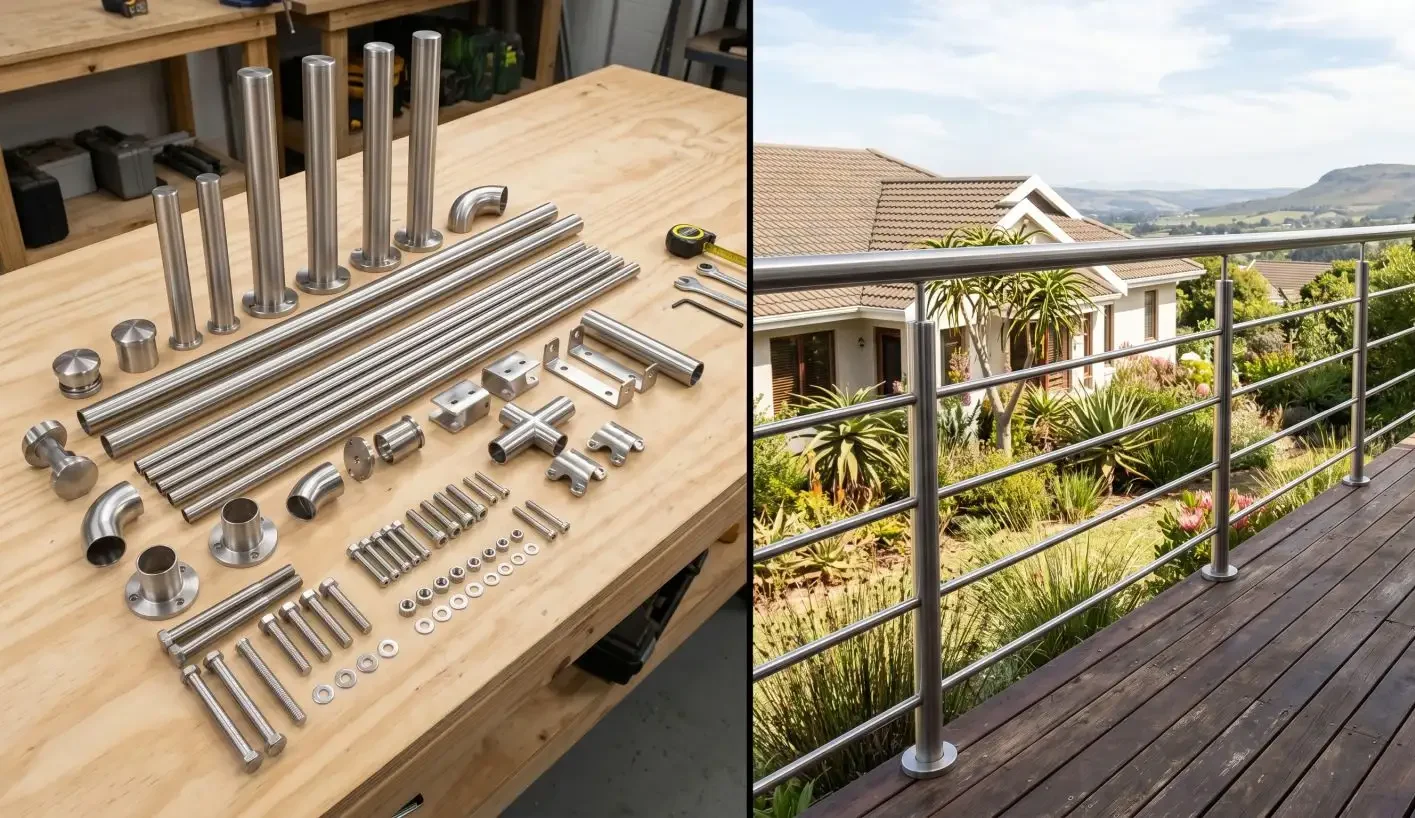
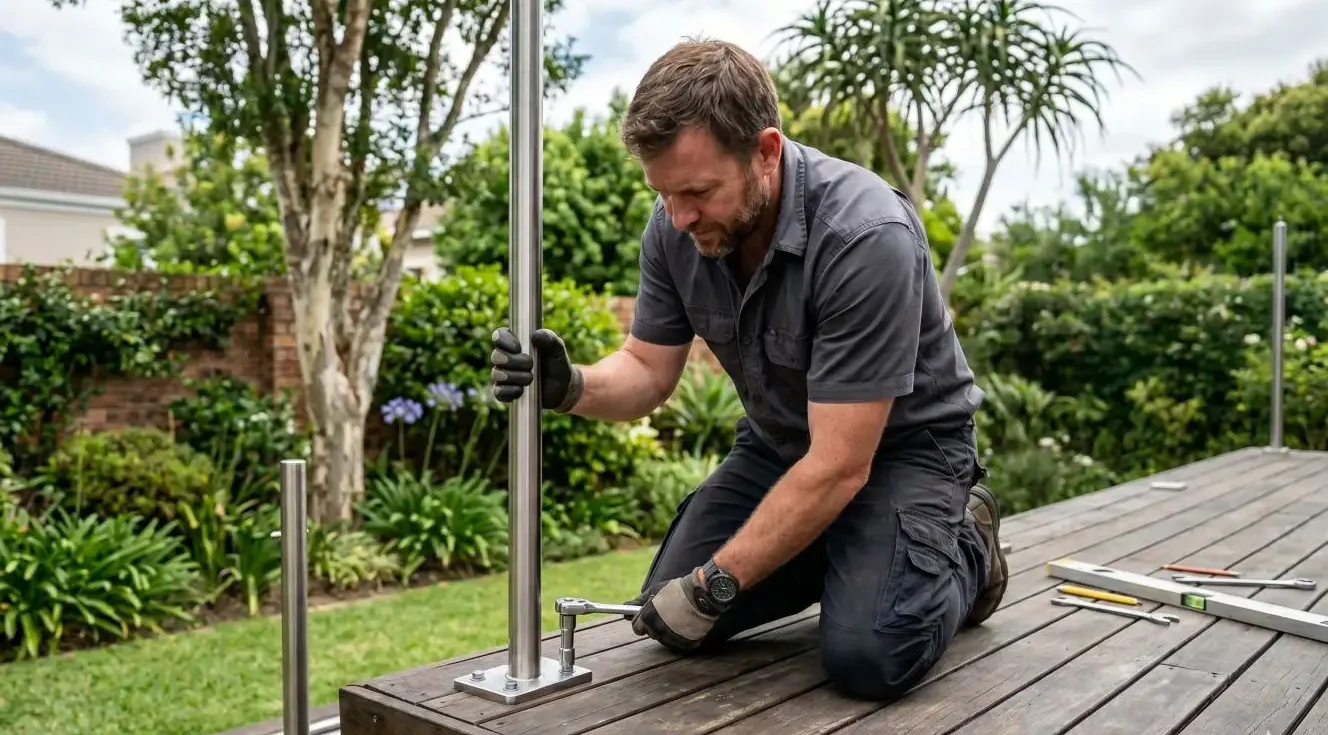
Balustrader’s pre-drilled stanchion systems are designed specifically to eliminate the need for welding. The stanchions arrive with infill holes already drilled at the correct positions for your chosen tube diameter. Assembly is a matter of threading tubing through the posts, positioning the stanchions at your marked intervals, drilling anchor holes, and securing the posts to your substrate with the correct fixings. No fabrication is required on site.
Projects that sit closer to the professional boundary include structural staircases with complex rake angles, installations into unusual or compromised substrates, and any project requiring formal engineering sign-off. If any of these apply to your situation, a professional quote is the right starting point — even if you ultimately decide to proceed DIY with an engineer’s guidance.
Getting a Realistic Budget for Your Project
The most accurate way to cost your project is to work from a full component list based on your measured run. That means knowing your linear metreage, your chosen infill style, your stanchion spacing, the substrate you are fixing into (timber, concrete, or steel), and whether your project is coastal or inland.
With those inputs confirmed, the component count becomes straightforward: number of stanchions at your chosen spacing, plus the tube or cable lengths required to span between them, plus the relevant fittings and hardware.
Balustrader offers a free DIY Estimate service. Send through your measurements and project details and the team will confirm a component list with pricing. This removes the guesswork from the budgeting stage and ensures you are ordering the right quantities before you commit.
You can reach the team at sales@balustrader.co.za or +27 64 044 1440, Monday to Friday, 08:00 to 17:00.
| What to have ready before you request an estimate • Total linear metreage of your planned balustrade run • Infill style preference — round tube, cable, or glass • Whether your property is coastal (within ~5km of sea) • Your fixing substrate — timber deck, concrete slab, or steel structure • Whether the run includes any staircase sections The more detail you can provide, the more accurate your estimate will be. |


