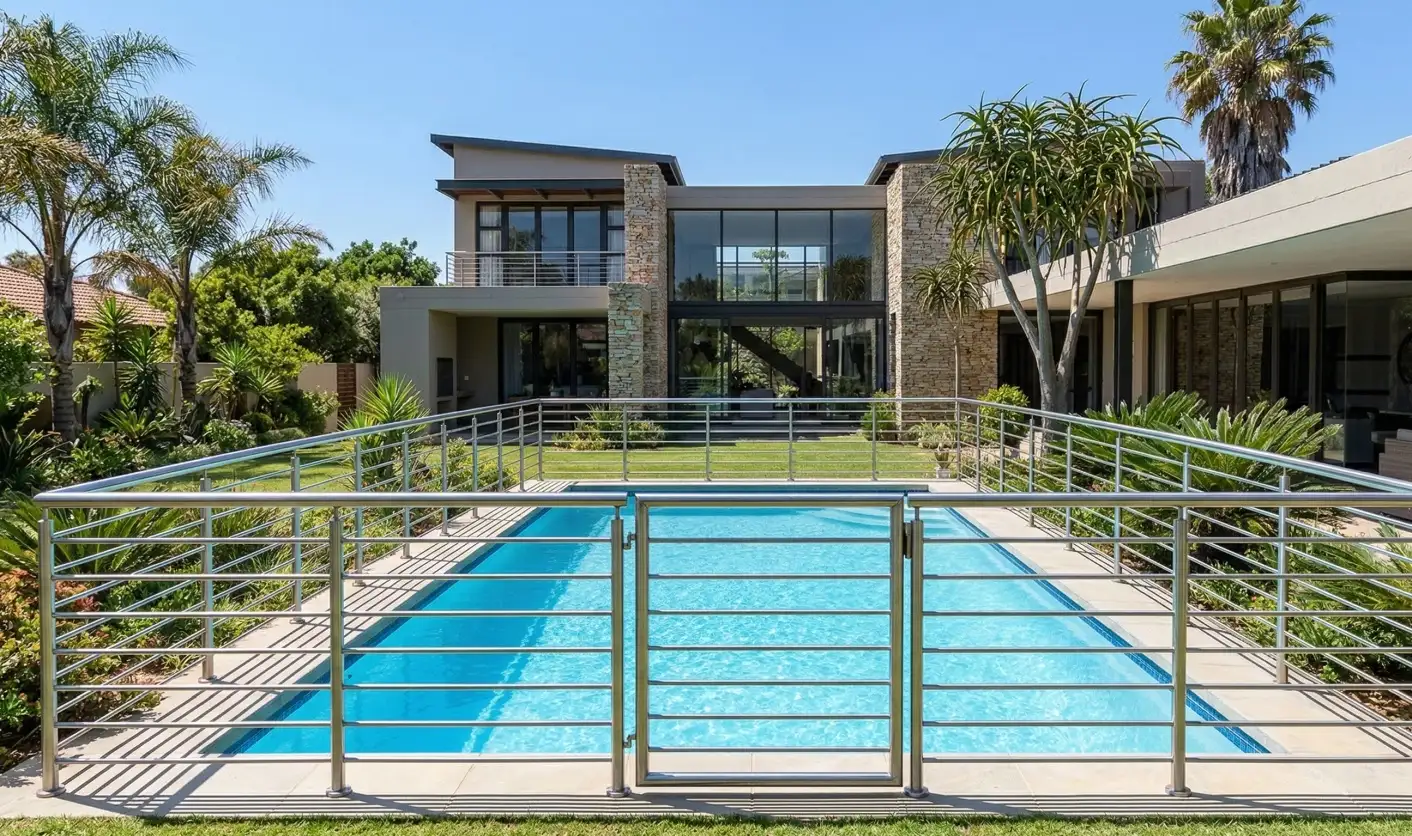
If you have a swimming pool on your property — or you’re planning to install one — pool fencing is not optional. South Africa’s national building regulations, combined with municipal by-laws in most major cities, require that any swimming pool accessible to children must be enclosed with compliant fencing. The consequences of non-compliance range from insurance complications to serious legal liability in the event of a drowning incident.
The relevant standard is SANS 10134: The Safety of Swimming Pools. This guide explains what SANS 10134 requires, how it differs from municipal by-laws, and what you need to know before planning or installing your pool fence.
What Is SANS 10134?
SANS 10134 is the South African National Standard that sets out minimum safety requirements for swimming pools. It covers the design, construction, and safety features of pools and their surrounds — including the fencing requirements that are most relevant to homeowners planning a DIY pool enclosure.
The standard is published by the South African Bureau of Standards (SABS) and is referenced in the National Building Regulations. While the standard itself sets a national baseline, it is important to understand that municipal by-laws — which vary by city and sometimes by suburb — frequently impose requirements that are more stringent than the national standard. In all cases, the more stringent requirement takes precedence.
The Key SANS 10134 Pool Fencing Requirements
Minimum fence height
The fence enclosing the pool must be a minimum of 1,200mm in height, measured from the finished ground level on the outside of the fence to the top of the fence. This is significantly higher than the 1,000mm minimum for general domestic balustrades under SANS 10400-M — the additional height is specifically intended to deter young children from climbing over.
No openings larger than 100mm
No opening in the fence may allow a 100mm sphere to pass through. This applies to the gaps between infill tubes, between the fence and the ground, and between the fence and any adjacent structure such as a wall or gate post. In practice, this means your infill tubes must be spaced at no more than approximately 90–95mm to comply.
Non-climbable construction
The fence must not be climbable. Horizontal elements within the lower 900mm of the fence that could serve as footholds are not permitted. This is a critical consideration when choosing your infill style — horizontal tube infill rails within reach of a child do not comply with this requirement unless they are spaced such that they cannot be used as a ladder.
For pool fencing specifically, many homeowners choose vertical tube infill or cable infill to satisfy the non-climbability requirement cleanly. Speak to our team if you are unsure whether your planned infill design complies.
Self-closing, self-latching gate
Any gate in the pool fence must be self-closing and self-latching. This means the gate must return to the closed and latched position automatically after being opened, without any manual action by the person passing through. The latch mechanism must be positioned or designed such that a child under five cannot operate it — typically this means the latch is on the pool side of the gate at a height above 1,500mm, or is a child-resistant mechanism.
This is one of the most commonly non-compliant elements of pool fences we see. A gate that needs to be manually pulled shut, or a latch that a toddler can reach, is a serious safety risk and a compliance failure.
No gaps at the base
The gap between the bottom of the fence and the ground must not allow a 100mm sphere to pass through — typically meaning a maximum gap of approximately 50–75mm depending on your fence profile. On uneven ground, this can require careful attention to post heights and infill positioning.
Fence must be independent of the house
The pool fence must enclose the pool independently — it cannot rely on the wall of the house as one side of the enclosure unless that wall has no doors or windows that open into the pool area. If the house wall has a door opening into the pool area, that door must comply with the same self-closing, self-latching requirements as a gate.
Municipal By-Laws: Why You Must Check Locally
As noted above, municipal by-laws frequently impose requirements beyond the national standard. In Cape Town, the City of Cape Town’s swimming pool by-laws contain specific provisions regarding fence height, gate requirements, and the responsibilities of the homeowner. Non-compliance with the applicable by-law — not just the national standard — is what creates legal exposure.
Before commencing any pool fencing project, contact your local municipality’s building department to obtain the applicable by-laws for your property. This is a simple step that takes the guesswork out of compliance planning.
Why Stainless Steel Is the Ideal Pool Fencing Material
Stainless steel is the material of choice for pool fencing for several reasons. It is inherently resistant to the moisture-rich, chlorine-exposed environment of a pool area — particularly 316 Marine Grade, which is the only grade we recommend for pool applications regardless of whether the property is coastal or inland.
Stainless steel fencing is also low-maintenance, long-lasting, and aesthetically versatile — it complements both modern and traditional homes and does not require painting, sealing, or periodic replacement the way timber or aluminium alternatives do.
What Happens If Your Pool Fence Is Non-Compliant?
The consequences of a non-compliant pool fence in South Africa are serious. From an insurance perspective, many home and liability insurance policies contain exclusions for accidents occurring in non-compliant pool areas. From a legal perspective, a homeowner whose non-compliant pool fence was a contributing factor in a drowning incident faces significant civil and potentially criminal liability.
Beyond the legal and safety implications, a non-compliant pool fence will fail a building inspection — which can delay property sales, complicate bond applications, and create complications with your municipality.
Getting Your Pool Fence Right With Balustrader
Balustrader’s DIY Estimate service is specifically designed to help homeowners plan compliant pool fencing. Submit your pool dimensions, perimeter layout, ground conditions, and gate requirements, and our team will produce a full component specification that meets both SANS 10134 and your local municipal requirements.
All pool area components are specified in 316 Marine Grade stainless steel as standard. We stock compliant self-closing gate hardware and can advise on the correct configuration for your specific layout.
Contact us: sales@balustrader.co.za | +27 64 044 1440 | www.balustrader.co.za | Mon–Fri 08:00–17:00
Plan a compliant pool fence — get your free DIY Estimate at www.balustrader.co.za


