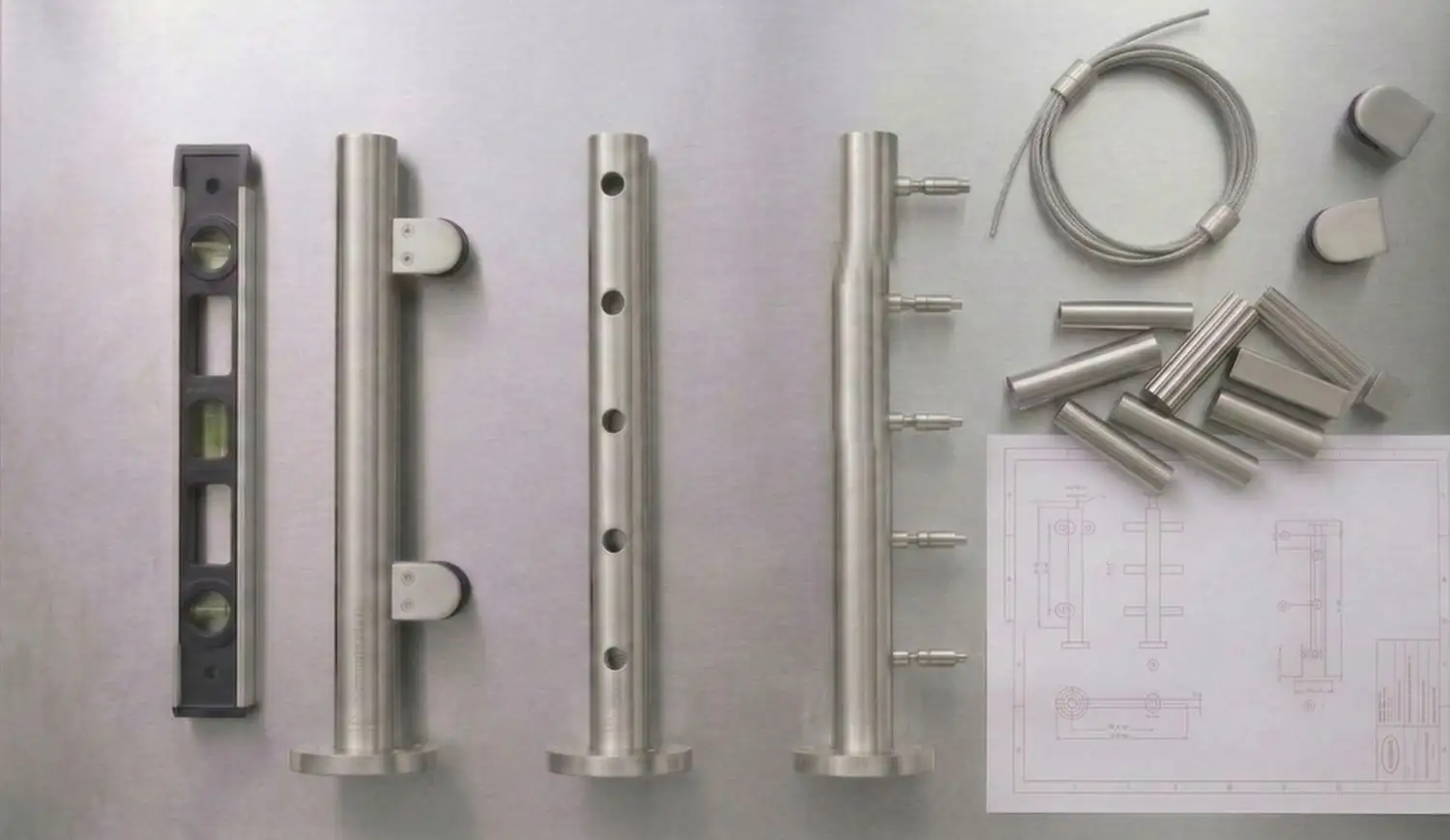
Stanchions are the structural posts that form the backbone of any balustrade system. They are bolted to the surface at regular intervals and carry the load of the entire installation. But not all stanchions are the same — and choosing the wrong variant for a particular position in your run is one of the most common ordering mistakes we see.
This guide explains every stanchion type in the Balustrader range, what each one is designed to do, and how to identify which variants you need for your specific project.
The Straight Stanchion
The straight stanchion is the workhorse of the system. It is the standard post used at all intermediate positions along a straight run — everywhere except corners, ends, and staircase sections. If your run is 8 metres with stanchions at 1,000mm spacing, the majority of your stanchions will be straight stanchions.
Straight stanchions are available in configurations for round tube infill (with pre-machined holes for the infill tubes) and for glass infill (smooth body, designed to accept slotted tube frames). Specify the correct infill configuration when ordering.
The Corner Stanchion
Corner stanchions are designed for use at positions where the balustrade changes direction. The most common variant is the 90-degree corner stanchion, which allows the infill run to turn a right angle — as you would encounter at the corner of a square or rectangular deck.
It is important to understand that a corner stanchion is not simply a straight stanchion placed at a corner. The post body is machined to accept infill tubes from two directions simultaneously, at the correct angle. Using a straight stanchion at a corner position results in infill tubes that cannot be properly fixed — a structural and aesthetic compromise.
If your deck or balcony has non-right-angle corners — 45-degree cuts, hexagonal shapes, or irregular angles — contact our team before ordering. We can advise on the correct corner stanchion variant for your specific angle.
The End Stanchion
End stanchions are used at the termination points of a run — the first and last posts where the balustrade begins and ends. They are typically positioned at the point where the balustrade meets a wall, a gate post, or simply terminates at the edge of a deck.
End stanchions are machined to accept infill tubes from one direction only, providing a clean, closed termination. Using a straight stanchion at an end position leaves the infill tube holes on one side exposed and unfinished — visually poor and potentially a safety issue.
The Stair Rake Stanchion
Stair rake stanchions are specifically designed for use on sloped staircases. Unlike straight stanchions — which are designed to accept horizontal infill tubes — rake stanchions are machined to accept infill tubes at the rake angle of the staircase, ensuring the infill runs parallel to the stair pitch rather than horizontally.
To order the correct rake stanchion for your staircase, you need to know your rake angle. Rake stanchions are available in a range of common staircase pitch angles. Our team will confirm the correct variant for your specific staircase based on the measurements you provide via the DIY Estimate service.
How to Count Your Stanchion Requirements
A complete stanchion order for a typical project will include:
- Straight stanchions — for all intermediate positions on straight runs
- Corner stanchions — one per change of direction in the run
- End stanchions — one for each end of each straight run that terminates freely (not at a corner)
- Stair rake stanchions — for all stanchion positions on staircase sections
The simplest way to count correctly is to draw your run as a plan, mark every stanchion position, and label each position as straight, corner, end, or stair. Then count each type separately. Submit this plan to our DIY Estimate service and we will verify your count and confirm the correct SKUs before you order.
Grade and Finish Selection
All stanchion variants are available in 304 stainless steel for inland applications and 316 Marine Grade for coastal and pool applications. Both grades are available in brushed satin and mirror polish finishes. The finish of your stanchions should match the finish of your tubing and fittings for a consistent result.
Matt Black powder-coated stanchions are also available for contemporary design applications. As with all powder-coated components, the base material is stainless steel — the coating is purely an aesthetic finish.
Still Unsure Which Stanchions You Need?
Our DIY Estimate service is the most reliable way to confirm your stanchion specification. Submit your project dimensions, a simple hand-drawn site plan, and your chosen infill style, and our team will produce a complete stanchion order list with the correct variants and quantities for every position in your run.
Contact us: sales@balustrader.co.za | +27 64 044 1440 | www.balustrader.co.za
Confirm your stanchion specification — get a free DIY Estimate at www.balustrader.co.za


