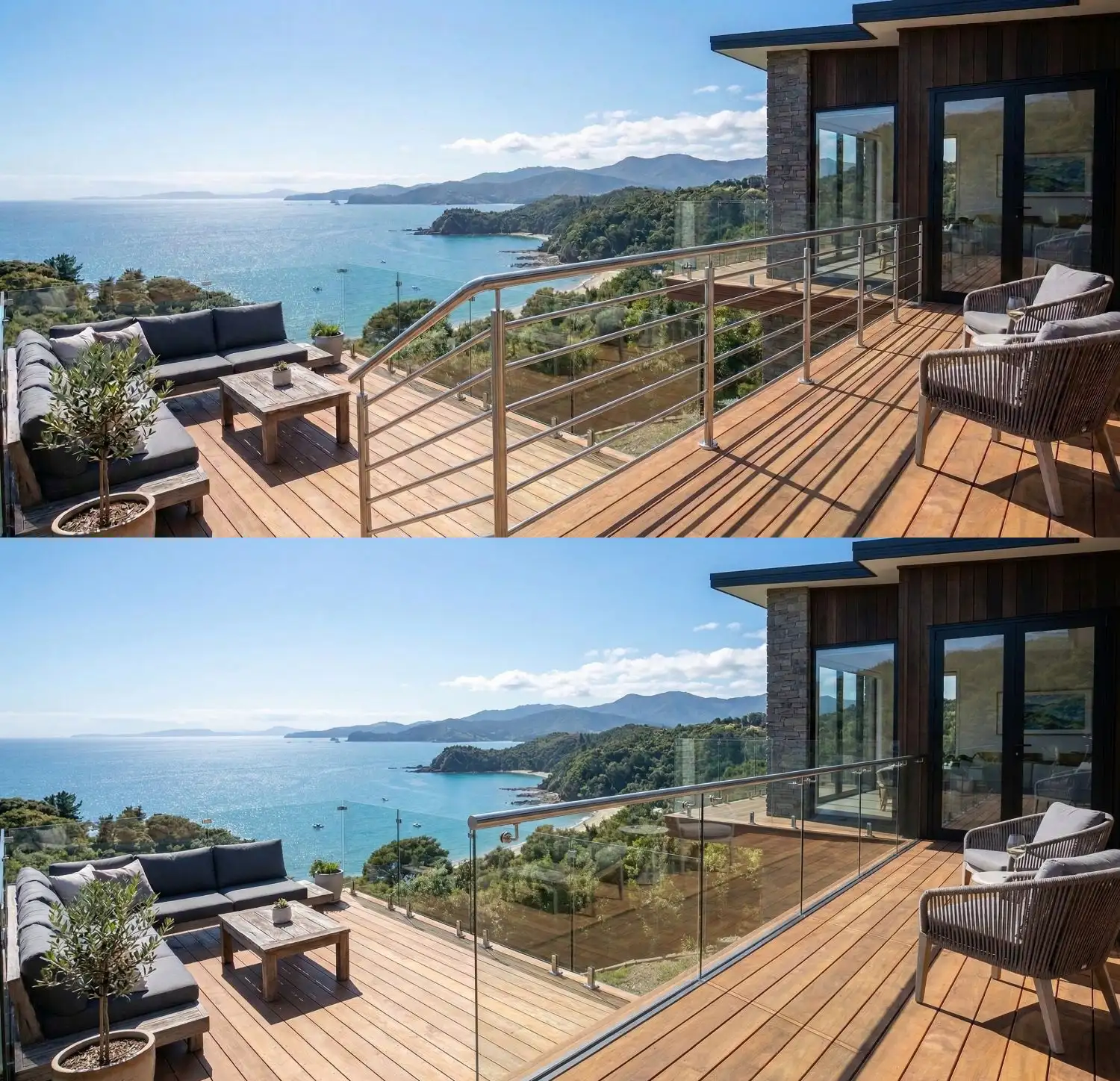
One of the first decisions you will make when planning a new balustrade is the infill style. The infill is everything between the stanchion posts — the part of the balustrade that provides the actual barrier and gives the installation its visual character. In the Balustrader system, the two primary infill options are round tube infill and glass panel infill using slotted tubing frames.
Both systems use the same bolt-down stanchion posts and are installed without welding. The choice between them comes down to a combination of aesthetics, budget, maintenance preferences, and the specific application. Here is an honest comparison.
Round Tube Infill
How it works
Horizontal round stainless steel tubes (50.8mm or 38.1mm diameter) pass through pre-machined holes in the stanchion posts at set heights. The tubes are cut to the bay width and slide through from one end of the run. The result is a clean, horizontal rail system that is immediately recognisable as a classic stainless steel balustrade.
Aesthetics
Round tube infill has a strong, architectural quality — it looks purposeful and substantial. It works particularly well on contemporary homes, industrial-aesthetic spaces, and outdoor entertainment areas where a defined visual boundary is desirable. The horizontal lines also complement the horizontality of deck boards and create a cohesive visual rhythm.
Cost
Round tube infill is the more cost-effective option. The components are straightforward to manufacture and the installation process is faster, which reduces both material and time costs. For budget-conscious DIY projects, tube infill is almost always the better starting point.
Maintenance
Tube infill requires regular cleaning of all tube surfaces — the multiple horizontal tubes create more surface area to maintain than a glass panel. In coastal or pool environments, each tube surface needs to be cleaned and passivated. That said, the process is straightforward and each tube is fully accessible.
Compliance
Tube infill systems are fully SANS 10400-M compliant when installed with the correct tube spacing (no opening larger than 100mm). For pool fencing under SANS 10134, horizontal tube infill can comply provided the tubes are spaced such that they cannot serve as footholds — our team will advise on the correct spacing for your specific configuration.
Glass Panel Infill
How it works
Toughened glass panels (12mm minimum thickness) are captured within a frame of horizontal slotted stainless steel tubing. The lower slotted tube sits at the base of the infill zone and the upper slotted tube at the top; the glass panel edge slots into both tubes and is sealed with neutral-cure silicone. The result is a frameless-looking glass panel within a minimal stainless steel border.
Aesthetics
Glass infill is the premium aesthetic choice. It is visually open — views through the balustrade are completely unobstructed — and has a lightweight, sophisticated quality that suits coastal homes, properties with significant views, and high-end residential projects. If your deck or balcony overlooks a garden, the ocean, or a mountain range, glass infill preserves that view in a way that tube infill cannot.
Cost
Glass infill carries a higher cost on two fronts: the slotted tubing and associated components are more expensive than round tube infill, and the glass panels themselves must be sourced separately from a glazier and cut to your exact specifications. The glass is not supplied by Balustrader — we supply the stainless steel framing, and you take our glass cut sizes to your local glazier.
Budget approximately 40–60% more for a glass infill installation compared to a comparable tube infill run.
Maintenance
Glass panels are easier to clean than multiple tube surfaces — a single panel surface per bay rather than five or six tubes. However, glass in coastal environments attracts salt deposits and requires regular rinsing and squeegee cleaning to prevent mineral build-up and etching. The silicone seals also need periodic inspection and replacement over the long term.
Compliance
12mm toughened safety glass panels comply with SANS 1263 for safety glazing and are fully SANS 10400-M compliant. Glass infill naturally satisfies the sphere rule and the non-climbability requirement, making it a straightforward compliance solution for pool fencing under SANS 10134 as well.
Side-by-Side Comparison
| Round Tube Infill | Glass Panel Infill |
| Lower component cost | Higher component cost |
| No additional trades required | Glazier required for glass panels |
| Classic, architectural aesthetic | Premium, open aesthetic |
| Partially obscures views | Fully preserves views |
| More surfaces to clean | Single panel surface per bay |
| Fully compliant — SANS 10400-M | Fully compliant — SANS 10400-M & 10134 |
| Ideal for most residential applications | Ideal for view properties and premium installs |
Which Should You Choose?
Choose round tube infill if: you are working to a tighter budget, your balustrade does not need to preserve a specific view, or you want a clean and straightforward DIY installation with the fastest possible turnaround.
Choose glass infill if: you have a significant view you want to preserve, you are investing in a premium aesthetic for a high-value property, or your pool fencing needs the cleanest possible compliance solution.
Both systems are available from Balustrader and both are installed using the same bolt-down stanchion posts — so your stanchion investment is the same regardless of infill choice. If you change your mind mid-project, the transition between infill types is simpler than you might expect.
Not sure which is right for your specific project? Submit a free DIY Estimate at www.balustrader.co.za and our team will discuss the options for your layout, budget, and environment.
Compare options for your project — get a free DIY Estimate at www.balustrader.co.za


