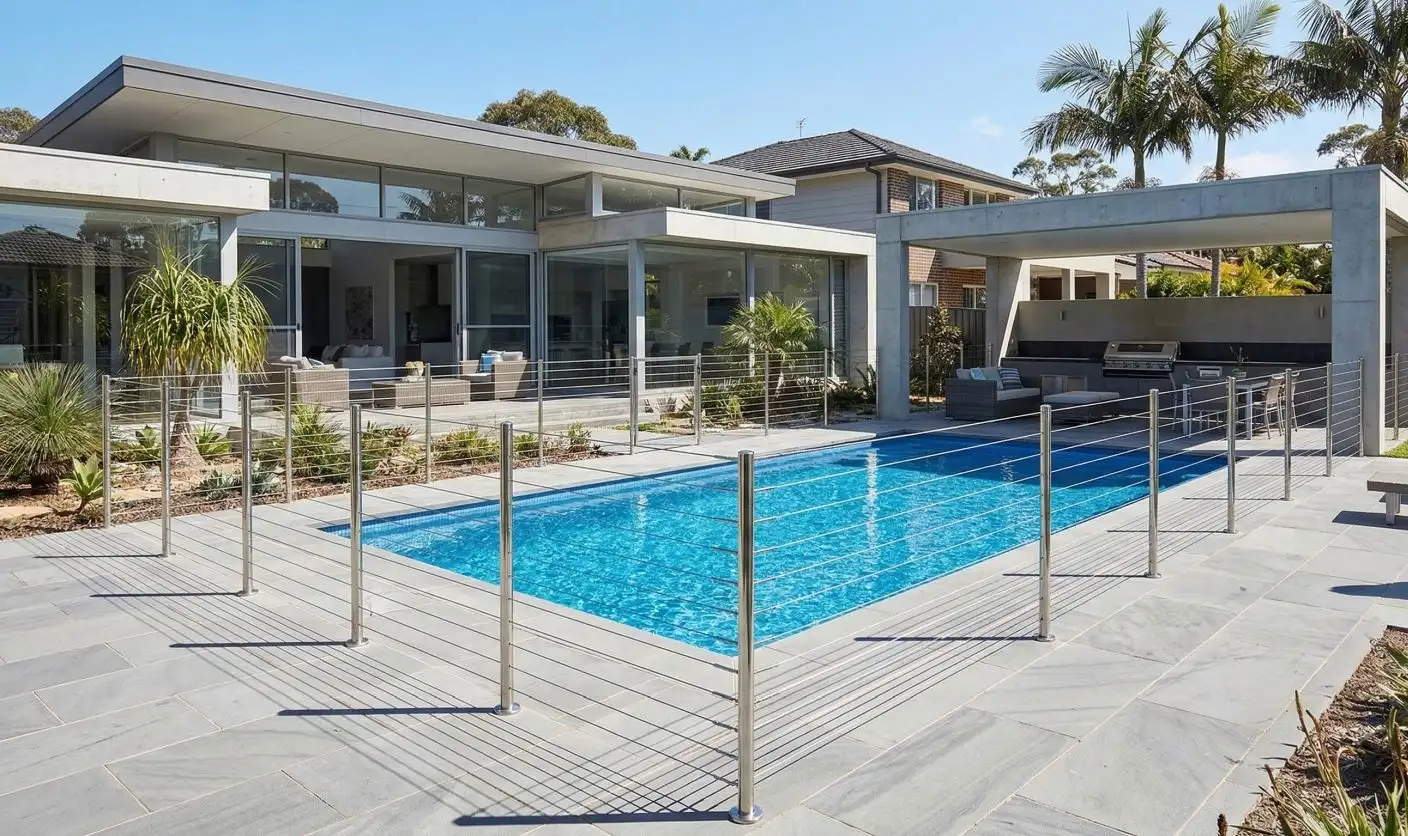
Pool area fencing is one of those projects where getting it right matters enormously — not just aesthetically, but legally and for the safety of your family. South African regulations require that any pool accessible to children must be enclosed with compliant fencing, and the consequences of non-compliance can be serious. The good news is that a stainless steel balustrade system is one of the best solutions available, and with Balustrader’s bolt-down system, it is entirely achievable as a DIY project.
The Legal Requirements for Pool Fencing in South Africa
Pool fencing requirements in South Africa are governed by SANS 10134 (the safety of swimming pools code) as well as local municipal by-laws, which in many cases are more stringent than the national standard. The key requirements typically include:
- The fence must be at least 1,200mm in height from ground level to the top of the fence
- There must be no openings that allow a 100mm sphere to pass through
- The fence must not be climbable — no horizontal rails within the lower 900mm that could serve as footholds
- Gates must be self-closing and self-latching, with the latch at a height or location that a small child cannot operate
- The fence must be non-climbable and non-scalable
Important: Always check your specific municipal by-laws before commencing installation, as requirements can vary by municipality. In Cape Town, the City of Cape Town’s swimming pool by-laws impose specific requirements that may differ from the national standard. Your local building authority can provide the applicable regulations for your property.
Why 316 Marine Grade Is Non-Negotiable for Pool Fencing
Around a swimming pool, you should always specify 316 Marine Grade stainless steel — even for inland properties. Pool water contains chlorine compounds that create a corrosive environment very similar to coastal salt air. Standard 304 grade will begin to show signs of corrosion within two to three years in a pool environment. 316’s molybdenum content gives it the chloride resistance needed to maintain its appearance and structural integrity long-term.
All Balustrader components are available in 316 Marine Grade. When completing your DIY Estimate, specify pool area application and we will ensure your component list is specified accordingly.
Planning Your Pool Balustrade
Pool area balustrades tend to involve more complexity than a simple straight deck run, typically including:
- Multiple straight runs around the pool perimeter
- Corner stanchions at changes in direction
- At least one gate opening with self-closing, self-latching hardware
- Possible integration with existing walls, steps, or structural elements
Spend time drawing a scaled plan of your pool area, marking the full fence line, all corners, all gate positions, and any sections where the fence will meet an existing wall or structure. This plan becomes the basis of your component order.
Infill Style Options for Pool Fencing
Round tube infill:
Horizontal round tubes (50.8mm or 38.1mm) spaced at compliant intervals through the stanchion bodies. This is the most cost-effective option and gives a clean, contemporary look. Ensure your tube spacing does not allow a 100mm sphere to pass through when calculating infill positions.
Glass infill:
12mm toughened glass panels in slotted tube frames provide an open, elegant look that is particularly popular for pool areas where you want an unobstructed view of the water. Glass panels must be toughened (tempered) safety glass to comply with SANS 1263. Note that Balustrader supplies the stainless steel framing components — glass panels are sourced from your local glazier cut to specification.
Gate Hardware
The gate is the most safety-critical element of a pool fence. You will need:
- A gate frame — fabricated from the same tubing as the fence for a consistent appearance
- Hinges — stainless steel, heavy-duty, and suitable for the gate weight
- A self-closing mechanism — either a gate spring or a self-closing hinge
- A self-latching catch — positioned on the pool side of the gate at a height not accessible to young children (typically above 1,500mm)
Our team can advise on appropriate gate hardware for your pool fence. This is one area where we strongly recommend not cutting corners — the gate must function reliably every single time.
Installation Process
The installation process for pool area balustrade follows the same general principles as a deck balustrade — layout, drilling, stanchion installation, infill fitting, and final checks — with the additional considerations of gate installation and the no-climbability requirement. Refer to our deck balustrade installation guide for the detailed step-by-step process, and contact our team for specific guidance on gate installation and compliance checking for your configuration.
Get Started
Pool area fencing is too important to leave to guesswork. Our DIY Estimate service is specifically designed to take the uncertainty out of the process — tell us your pool dimensions, perimeter layout, gate requirements, and surface type, and we’ll provide a complete, compliance-ready specification.
Contact us at sales@balustrader.co.za, call +27 64 044 1440, or visit www.balustrader.co.za.
Get a compliance-ready pool fencing estimate at www.balustrader.co.za


